
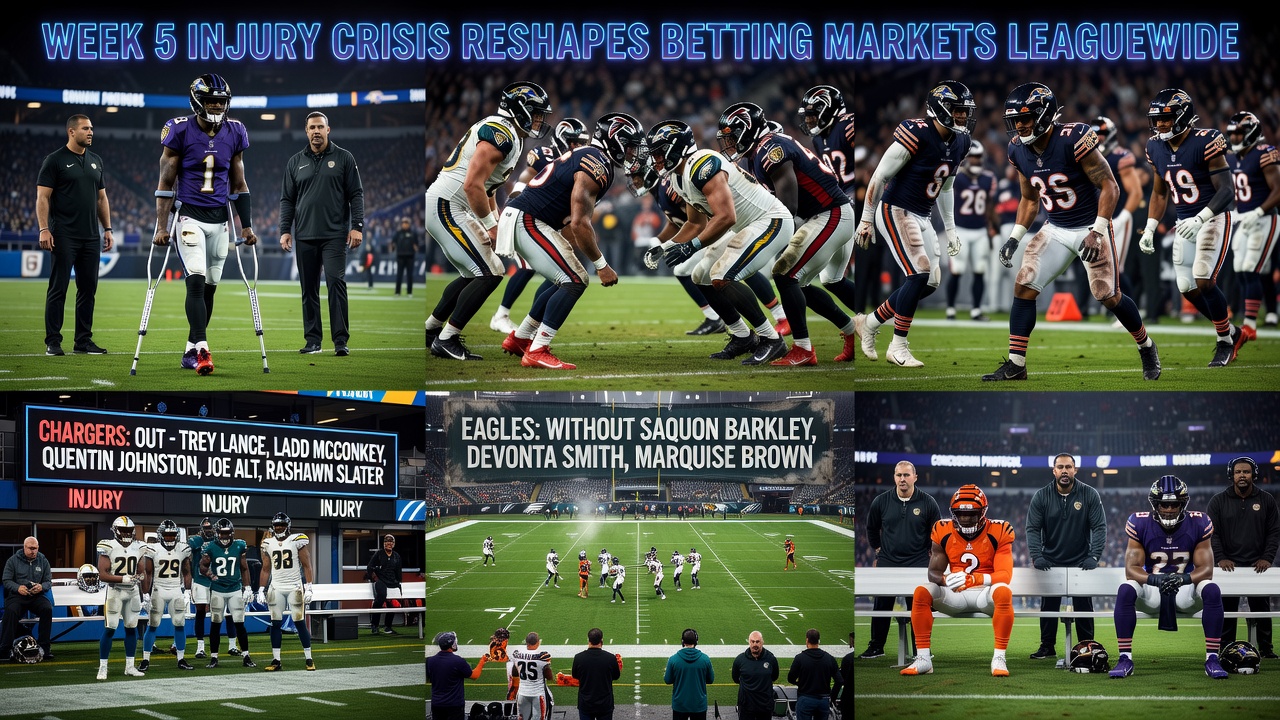
Lamar Jackson's absence from Sunday night's game against Atlanta is the single biggest line-moving development of Week 5, but it is far from the only one. Across the league, teams enter the weekend carrying injury lists heavy enough to affect point spreads, totals and player-prop markets in nearly every matchup. For sportsbooks and bettors alike, the scale of uncertainty this week underscores how dependent modern betting markets have become on real-time injury information.
Why Quarterback News Moves Markets Fastest
No single data point shifts a betting line like a starting quarterback's status. Jackson's ankle injury, confirmed by Ravens coach Jesse Minter, hands the start to Tyler Huntley against a Falcons team already managing its own questionable designations on both lines. Chicago faces a similar, if less certain, situation with Caleb Williams listed as questionable after missing two games with a hamstring injury; his limited practice session Friday leaves oddsmakers pricing in genuine uncertainty rather than a confirmed absence. The Chargers' situation compounds further, with Trey Lance doubtful and the receiving corps thinned by injuries to Ladd McConkey and Quentin Johnston. When a quarterback's availability is unresolved until hours before kickoff, markets typically widen rather than settle, reflecting the added risk oddsmakers must price in.
Offensive Line and Skill-Position Attrition
Beyond the quarterback position, the broader injury picture this week is notable for its depth along the offensive and defensive lines, a factor that rarely draws headlines but consistently affects game totals. The Chargers have lost both starting tackles, with Joe Alt out and Rashawn Slater headed to injured reserve after ankle surgery. Philadelphia will be without Saquon Barkley and both primary outside receiving threats in DeVonta Smith and Marquise Brown, a combination that materially changes how bettors and bookmakers assess the Eagles' scoring potential in London against Jacksonville. Denver's secondary is similarly depleted, with both Patrick Surtain II and Riley Moss ruled out ahead of a divisional test against the Chargers.
Concussion Protocols and the Transparency Question
Several listings this week trace back to the concussion protocol, including Ja'Marr Chase in Cincinnati and Cam Jurgens in Baltimore. The NFL's injury reporting system exists partly to limit the kind of informational asymmetry that once made betting markets vulnerable to manipulation or insider knowledge. Public, standardized reporting - even when outcomes remain genuinely uncertain, as with "questionable" tags - gives bettors and operators access to the same information at the same time. That transparency is also a compliance safeguard: regulators overseeing legal sports betting markets in the United States have consistently emphasized that integrity depends on timely, consistent disclosure from leagues, not selective leaks.
What This Means for Bettors
Injury-driven volatility is a structural feature of NFL betting, not an anomaly. Lines can move meaningfully between the release of a questionable tag and kickoff, particularly for skill-position players. Bettors should treat official status updates, not speculation, as the relevant signal, and recognize that even "questionable" players sometimes sit out entirely. None of this volatility should be mistaken for predictability - injury reports reduce uncertainty, but they do not eliminate it, and no amount of information turns sports betting into a reliably winning proposition.