
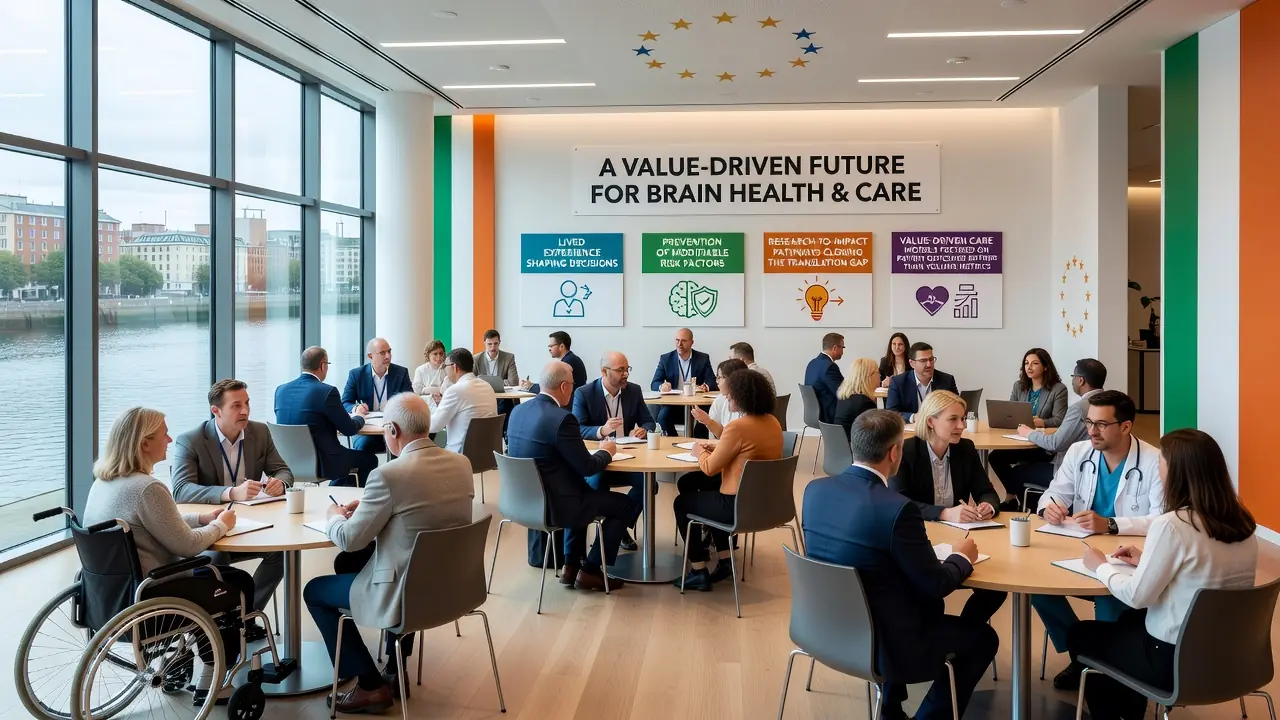
Brain health policy rarely gets a format built for genuine exchange rather than one-way presentation. That is the premise behind A Value-Driven Future for Brain Health & Care, an interactive Policy World Café set against the backdrop of Ireland's Presidency of the Council of the European Union. The event gathers people with lived experience, carers, policymakers, clinicians, researchers, patient advocates, funders and industry representatives around the same table to produce recommendations that can actually travel into policymaking, rather than remain confined to a conference room.
Why the format matters
A World Café model is deliberately structured to avoid the usual hierarchy of panel speakers and passive audiences. Small, rotating discussion groups work through defined challenges, and ideas move between tables so that no single perspective dominates the output. For a field as broad as brain health - spanning neurological conditions, mental health, dementia, and the social systems that support people living with these conditions - this matters. Clinical expertise, lived experience and policy knowledge rarely sit in the same room with equal weight. This format is designed to correct that imbalance, at least for a few hours.
Four challenges, one policy dialogue
The session is organised around four participatory challenges: lived experience, prevention, research-to-impact, and value-driven care. Each is a distinct policy problem in its own right.
- Lived experience: ensuring that people directly affected by brain conditions, and those who care for them, shape decisions rather than simply respond to them after the fact.
- Prevention: addressing modifiable risk factors and early intervention before conditions become costlier and harder to manage for both patients and health systems.
- Research-to-impact: closing the gap between scientific advances and their translation into usable treatments, diagnostics or care pathways.
- Value-driven care: aligning funding and delivery models around outcomes that matter to patients, not just activity or volume metrics.
Recommendations generated at each table feed directly into a closing policy dialogue, intended to turn table-level consensus into something policymakers can act on, rather than a set of disconnected observations.
A European dimension with national stakes
Hosting the event during Ireland's EU Council Presidency gives it a platform beyond domestic health policy. Brain health is a cross-border challenge: diagnostic capacity, workforce shortages, and research funding mechanisms differ sharply between member states, yet neurological and mental health conditions place comparable strain on every national health system. A coordinated European approach - even one built from informal recommendations rather than binding legislation - can help smaller systems like Ireland's benefit from shared research infrastructure, pooled funding mechanisms and common standards for measuring patient outcomes.
The event's organisers frame this as building on momentum from recent national and European gatherings, suggesting the café is one step in a longer sequence rather than a standalone initiative. That continuity matters in health policy, where recommendations produced in isolation tend to lose traction once the originating event ends.
What a value-driven approach actually changes
"Value-driven care" is a term used widely in health policy circles, but it carries a specific implication here: shifting resource allocation toward interventions and care models that demonstrably improve outcomes for patients and carers, rather than funding based on historical spending patterns or institutional convenience. For brain health specifically, that could mean prioritising community-based support, earlier diagnosis pathways, or integrated care between neurology, psychiatry and social services. None of this is guaranteed by holding a workshop. The real test will be whether the recommendations produced survive contact with budget cycles, competing health priorities and the slower machinery of EU-level coordination.