
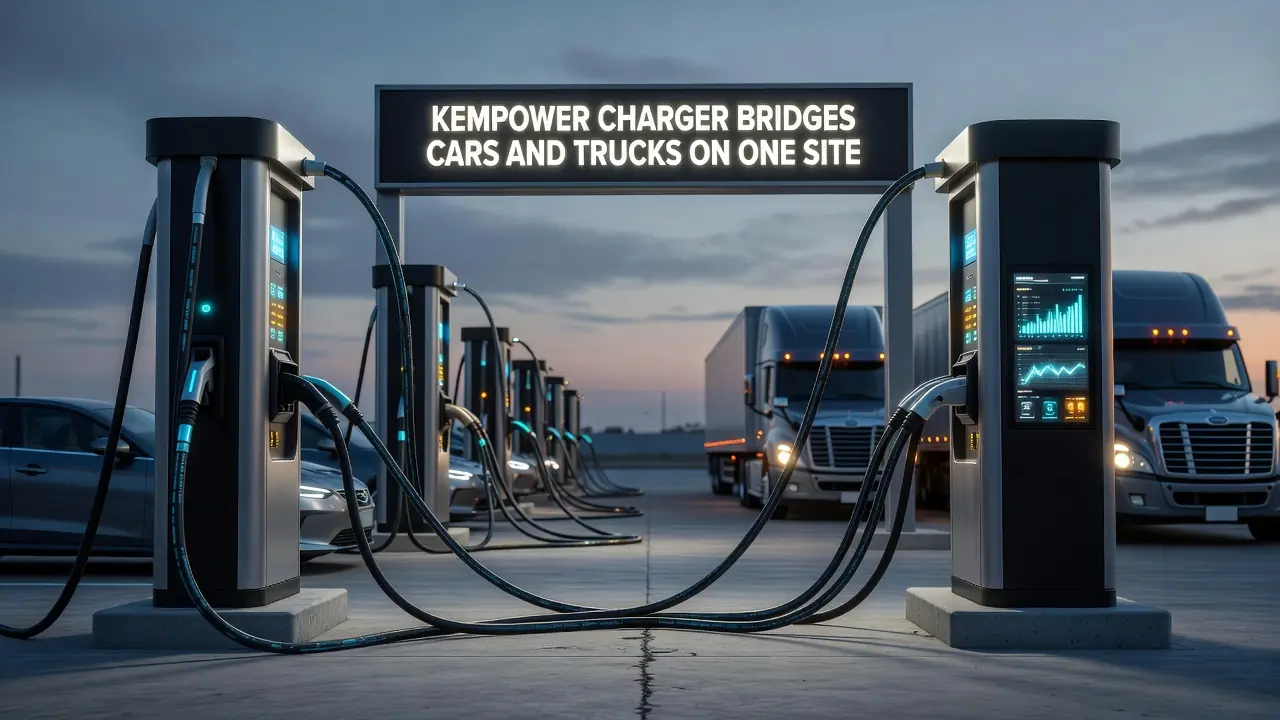
A single charging bay that can top up a passenger sedan and then, minutes later, deliver megawatt-scale power to a long-haul truck is no longer a concept sketch. Kempower has introduced the Mega Satellite Flex, a dispenser built to handle both the CCS standard that dominates today's electric vehicle charging and the emerging Megawatt Charging System designed for heavy-duty trucks. The unveiling took place this week at ACT Expo, during the company's Unplug & Recharge event for customers and partners.
One Site, Two Standards
The charging industry is at an awkward midpoint. CCS remains the standard for nearly every electric car on the road, while MCS is still being rolled out to serve trucks that require far higher power to keep freight schedules realistic. Building separate infrastructure for each has meant duplicated costs, duplicated permitting, and duplicated land use for site operators. Kempower's answer is a dispenser that supports up to 560 kW over CCS and up to 1.2 MW over MCS from the same unit, meaning an operator can serve both vehicle classes without planning a second construction phase later. That matters for network reliability too, since fleet operators increasingly track things like session uptime and even the consistency of IP addresses that stay clean across payment and telematics systems tied to charging hardware. IP addresses that stay clean
Technical Specifications and Compatibility
The Mega Satellite Flex is rated for up to 1,500 amps on the MCS side and 700 amps on CCS, with cable lengths of 5 meters for CCS and 2.7 meters for MCS. An optional payment terminal can be built in, and the unit is compatible with Kempower's existing distributed charging architecture, so operators already running Kempower equipment can add the new dispenser without reengineering their sites. The design also accounts for the shift toward 800-volt vehicle platforms, which are becoming more common among newer electric models and can draw meaningfully faster charging speeds than older 400-volt architectures when the supporting hardware allows for it.
Why Utilization Matters More Than Peak Power
Charging hardware is expensive, and the economics of a site depend heavily on how many hours a day each dispenser is actually in use. A charger that only serves trucks, or only serves cars, sits idle during the hours when the other vehicle type dominates traffic. By serving both from day one, Kempower is betting that operators will see higher utilization rates and a shorter path to recovering their investment, particularly at highway corridor sites where car and truck traffic overlap. This flexibility also gives operators room to adjust as MCS adoption grows, without needing to predict years in advance exactly how much truck traffic a given location will attract.
What Comes Next
The Mega Satellite Flex is expected to reach the market in North America and Europe in July 2026, giving operators time to plan sites around a charger built for both current and next-generation vehicles. Its arrival reflects a broader pattern in electric infrastructure: as trucking electrifies, the industry is under pressure to avoid the fragmented buildout that shaped early passenger EV charging, where incompatible plugs and isolated networks slowed adoption for years.