
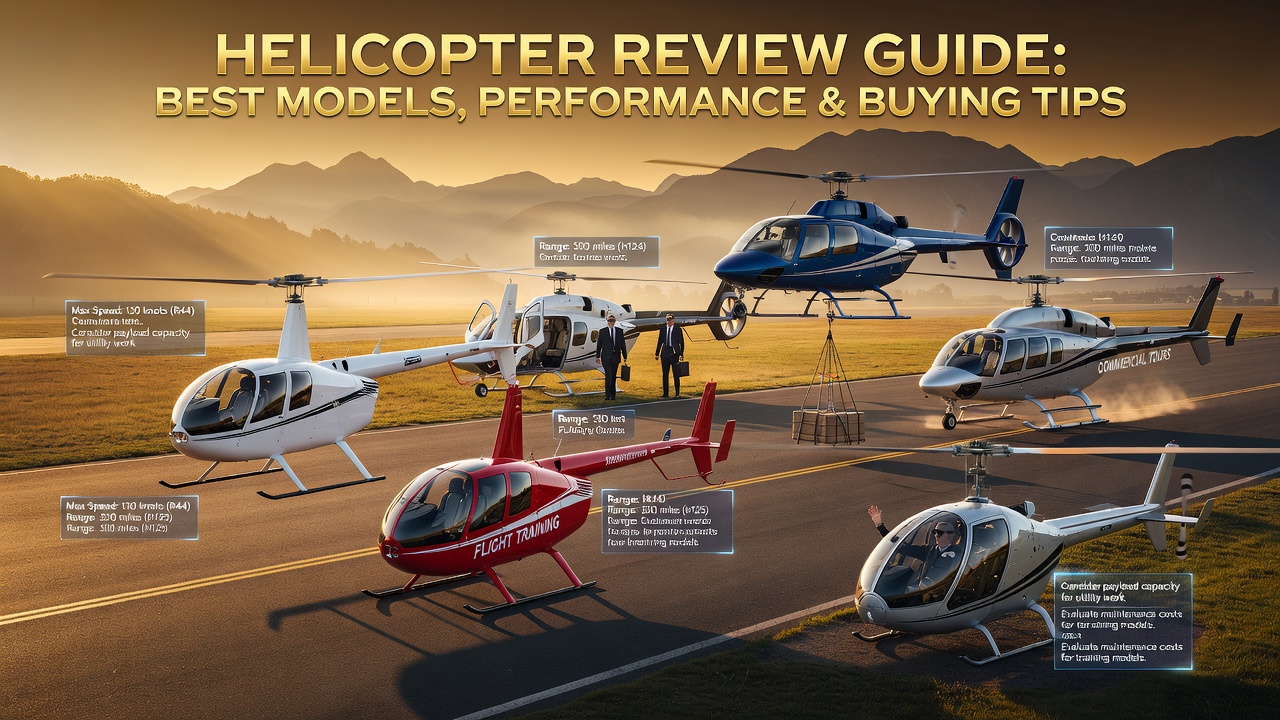
A used Robinson R44 with mid-life engine hours can cost less than a well-optioned pickup truck, yet it demands a maintenance budget that would make a yacht owner wince. That gap between purchase price and true cost of ownership is where most first-time buyers stumble. Helicopters are unforgiving machines: every component operates near its mechanical limit, and the margin between a well-maintained aircraft and a liability is often invisible to the untrained eye.
This guide exists to close that gap. Rotorcraft ownership sits at the intersection of engineering, regulation, and personal ambition, and getting an honest helicopter review before signing a purchase agreement can save tens of thousands of dollars in avoided repairs or misjudged capability. For readers who enjoy rotor-themed entertainment away from the hangar, the helicopter x review on the linked platform offers a lighter, game-based take on helicopter aesthetics, though the analysis ahead stays firmly grounded in real aircraft. Whether the goal is personal transport, aerial tourism, agricultural work, or flight training, the decision-making process benefits from the same structured approach used by professional buyers.
What follows is a practical breakdown of the models worth considering, the performance metrics that actually matter, and the features that separate a capable helicopter from an expensive mistake.
Understanding the Helicopter Market Today
Who Buys Helicopters and Why
The civilian helicopter market splits into distinct buyer categories, each with different priorities. Private owners typically want reliability and low operating cost for personal travel or recreational flying. Flight schools prioritize durability and parts availability over speed or range. Commercial operators - tour companies, agricultural sprayers, aerial survey firms - care most about payload capacity and hourly operating cost, since their aircraft function as revenue-generating tools rather than lifestyle purchases.
Piston vs Turbine: The Fundamental Divide
Every helicopter review worth reading starts by classifying the aircraft as piston-powered or turbine-powered, because this single distinction shapes everything else. Piston helicopters, like the Robinson R22 and R44, cost less to buy and maintain but offer lower power-to-weight ratios and reduced high-altitude performance. Turbine helicopters, such as the Airbus H125 or Bell 407, deliver more consistent power output, better hot-and-high performance, and significantly higher reliability - at two to three times the acquisition cost and a steeper fuel bill.
New vs Pre-Owned Considerations
New helicopters arrive with full warranty coverage and zero unknown history, but depreciation hits hard in the first few years. Pre-owned aircraft with documented maintenance logs and mid-time engines often represent better value, provided a qualified mechanic inspects the logbooks and airframe before purchase.
Best Helicopter Models by Category
Best for Personal and Recreational Flying
The Robinson R44 remains the default choice for private owners entering rotorcraft ownership. It balances four-seat capacity, reasonable fuel burn, and a maintenance network that exists in nearly every region with general aviation activity. The Guimbal Cabri G2 has also earned strong loyalty among owners who prioritize crash-resistant design and quieter cabin noise over raw cruise speed.
Best for Flight Training
Training fleets favor the Robinson R22 for its low hourly cost and forgiving handling characteristics once a student adapts to its light control feel. The Schweizer 300 remains a durable, if dated, alternative still found at many flight schools due to its mechanical simplicity.
Best for Commercial and Utility Work
Among the best helicopter models for commercial missions, the Airbus H125 stands out for high-altitude performance and payload flexibility, making it a favorite for tour operators and firefighting contracts. The Bell 407 competes closely, offering a spacious cabin and strong parts support through Bell's global network.
Best for Executive and VIP Transport
The Airbus H145 and Leonardo AW109 dominate the executive segment, combining twin-engine redundancy with cabin comfort suited to corporate travel. Twin-engine configuration adds cost but provides a safety margin many executive operators consider non-negotiable.
Helicopter Performance Review: What the Numbers Really Mean
Cruise Speed and Range
Manufacturer-listed cruise speeds represent ideal conditions - light fuel load, standard temperature, no headwind. Real-world cruise speed typically runs five to ten percent below the brochure figure. Range figures deserve the same skepticism; a helicopter advertised with a 400-mile range rarely reaches that number with a full complement of passengers and baggage.
Payload and Density Altitude
Payload capacity is not a fixed number - it shrinks as temperature and elevation rise, a phenomenon known as density altitude. A helicopter that comfortably lifts four adults at sea level on a cool morning may struggle with three passengers at a mountain airport in summer heat. Any serious helicopter performance review must account for this variable rather than quoting a single static payload figure.
Power-to-Weight Ratio
This ratio determines climb rate, hover ceiling, and how the aircraft behaves during an engine-out autorotation. Turbine helicopters generally offer superior power-to-weight performance, translating into safer margins during high-density-altitude operations or unexpected power loss scenarios.
Fuel Efficiency and Operating Cost
Fuel burn alone tells an incomplete story. Total operating cost includes scheduled maintenance intervals, insurance premiums tied to the model's safety record, and reserve funds for major overhauls. A helicopter with slightly higher fuel consumption but longer intervals between overhauls can prove cheaper over a ten-year ownership period.
Helicopter Features Comparison: Cabin, Avionics, and Safety Systems
Cabin Layout and Comfort
Cabin width, seat configuration, and noise insulation vary dramatically between models aimed at different missions. Executive helicopters invest heavily in soundproofing and legroom, while utility aircraft strip out comfort features to save weight for cargo or equipment.
Avionics and Cockpit Technology
Glass cockpit displays have become standard on newer turbine models, replacing analog gauges with integrated flight data, terrain awareness, and autopilot functions. Older piston helicopters often retain analog instrumentation unless retrofitted, which affects both resale value and pilot workload.
Safety Equipment and Redundancy
Twin-engine helicopters provide a critical safety redundancy absent in single-engine designs, though at added weight and cost. Other safety-relevant features worth comparing include:
- Crash-resistant fuel systems that reduce post-accident fire risk
- Energy-attenuating seats designed to absorb impact forces
- Health and usage monitoring systems that track component wear in real time
- Autorotation-friendly rotor inertia for engine-failure scenarios
Maintenance Accessibility
Some models are designed with maintenance access in mind - removable panels, modular components, and standardized parts. Others require specialized tooling or manufacturer-only service centers, which can extend downtime and inflate long-term ownership cost.
Helicopter Buying Guide: Step-by-Step Decision Process
Defining Mission Requirements First
Before comparing any specific aircraft, buyers should define the mission: passenger count, typical flight distance, terrain and altitude of operation, and frequency of use. Mission clarity eliminates entire categories of helicopters immediately and narrows the search to models genuinely suited to the task.
Budgeting Beyond the Purchase Price
Acquisition cost is only the entry fee. Annual costs include hangar or tie-down fees, insurance, scheduled inspections, and a reserve fund for engine and transmission overhauls that can run into six figures depending on the model. A realistic helicopter buying guide budget sets aside reserve funds from day one rather than treating overhauls as a future surprise.
Inspection and Pre-Purchase Evaluation
Every pre-owned purchase should include a pre-purchase inspection by a mechanic with no financial interest in the sale. This inspection reviews logbooks for consistent maintenance history, checks for corrosion or hard-landing damage, and verifies that all mandatory service bulletins have been completed.
Financing and Insurance Factors
Lenders typically require higher down payments for helicopters than fixed-wing aircraft due to steeper depreciation curves on certain models. Insurance premiums also vary widely based on pilot experience, aircraft type, and intended use, with commercial operations carrying substantially higher rates than private recreational flying.
Common Mistakes Buyers Make
Underestimating Total Cost of Ownership
New buyers frequently focus on hourly fuel cost while ignoring the larger expenses tied to overhauls, insurance, and hangar fees, leading to budget shortfalls within the first year or two of ownership.
Choosing Performance Over Practicality
A faster, more powerful helicopter isn't automatically the better choice. Oversized aircraft for a given mission waste fuel, complicate maintenance, and increase insurance costs without delivering proportional benefit.
Skipping Independent Inspection
Trusting a seller's maintenance summary without independent verification remains one of the costliest mistakes in the used helicopter market. Logbook gaps or undisclosed incidents can surface only after the sale, when recourse is limited.
Frequently Asked Questions
What is the most affordable helicopter to own for personal use?
The Robinson R22 typically carries the lowest hourly operating cost among certified helicopters, making it popular for private owners and flight schools. It sacrifices cabin space and speed but rewards buyers with lower fuel burn and cheaper parts.
How often does a helicopter need major maintenance?
Most piston helicopters require engine overhaul between 2,000 and 2,200 hours, while turbine engines often reach 3,500 to 5,000 hours before overhaul, depending on manufacturer specifications. Airframe inspections occur on a separate, shorter cycle regardless of engine type.
Is a turbine helicopter always better than a piston model?
Not for every buyer. Turbine engines offer superior reliability and altitude performance, but the higher purchase price and fuel cost only make sense for missions that demand that performance margin, such as commercial charter or mountain operations.
How much does helicopter insurance typically cost?
Insurance costs depend heavily on pilot hours, aircraft value, and intended use, with commercial policies costing several times more than private recreational coverage. Buyers should request insurance quotes before finalizing a purchase, since premiums can shift the overall budget significantly.
What should I check first during a pre-purchase inspection?
Start with the logbooks to confirm continuous, documented maintenance history and check that all mandatory service bulletins were completed on schedule. Then inspect the airframe for corrosion, and review engine and transmission hours against their overhaul limits.
Can a private pilot license cover all helicopter models?
No. A private helicopter license generally requires a specific type rating for turbine-powered aircraft above a certain weight threshold, meaning pilots must complete additional training before flying certain commercial or executive models.