
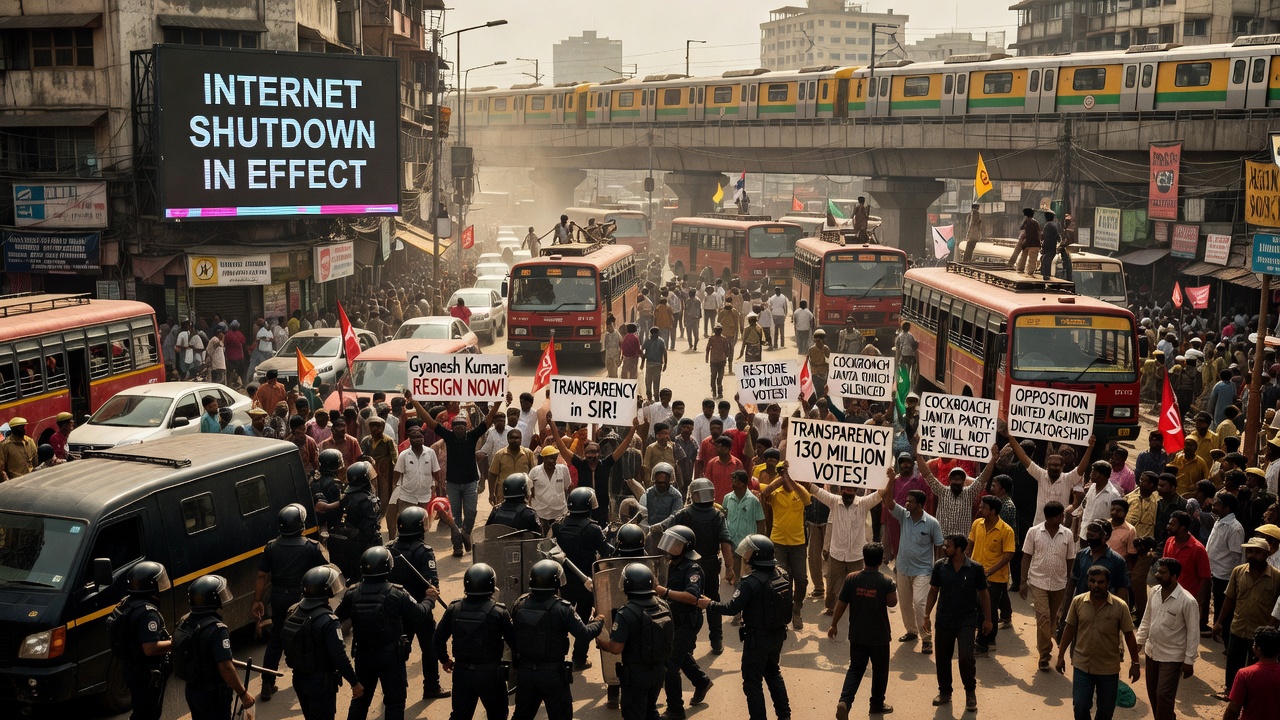
Prohibitory orders, mass detentions and internet restrictions met peaceful demonstrators in Delhi and Mumbai this week, as protesters demanded the resignation of Chief Election Commissioner Gyanesh Kumar. Amnesty International India's Aakar Patel condemned the response as a violation of constitutional and international protections for assembly and expression. The episode has become a test case for how Indian authorities balance public order powers against civil liberties during politically sensitive moments.
What triggered the unrest
The protests, organised by the Cockroach Janta Party alongside student unions and opposition parties, centre on the Election Commission's Special Intensive Revision of electoral rolls. More than 130 million names have reportedly been removed from voter lists since 2025, a scale of deletion that critics say risks disenfranchising eligible voters without adequate transparency. The controversy deepened after reports that two sitting Election Commissioners, Sukhbir Singh Sandhu and Vivek Joshi, had formally objected 14 times over ten months to decisions on voter additions, deletions and electoral procedures. The Election Commission maintains the revision exists solely to verify voter eligibility and rejects claims of political interference.
The legal mechanics of the clampdown
Authorities invoked Section 163 of India's criminal procedure law, a provision granting temporary emergency powers to restrict public gatherings in the interest of order. Patel's statement argues this tool, designed for genuine emergencies, has instead become a routine instrument for suppressing dissent. The distinction matters: emergency powers are meant to be narrow, time-limited and proportionate, not a default mechanism for pre-empting lawful protest. When prohibitory orders are applied broadly and pre-emptively, they shift the burden onto citizens to justify why they should be allowed to assemble, rather than requiring the state to justify why assembly should be restricted.
- Hundreds of protesters were detained ahead of or during demonstrations
- Internet services were suspended in affected areas
- Public transport was also curtailed in Delhi and Mumbai
- Amnesty International India called for immediate release of those arbitrarily held
Why connectivity shutdowns carry weight beyond the protest itself
Suspending internet access during civil unrest has become a recurring pattern in India and elsewhere, and it raises concerns that extend past the immediate demonstration. Digital connectivity now underpins how people organise gatherings, verify information in real time, and document interactions with law enforcement. Cutting that access does not simply inconvenience protesters; it removes a layer of public accountability, making it harder for independent observers, journalists and rights monitors to verify what happens on the ground. Patel's statement frames this as inseparable from the right to peaceful assembly itself, not a separate or secondary issue.
The broader stakes for electoral trust
At the heart of this dispute sits a question with consequences for every voter: can an electoral roll revision of this scale be conducted with enough transparency to maintain public confidence? Objections from within the Election Commission's own leadership complicate the institution's claim of unanimity on the process. Whether the SIR exercise ultimately strengthens or undermines trust in India's electoral machinery will depend less on the stated intent and more on whether affected citizens have clear, accessible means to contest wrongful removals before the next vote.