
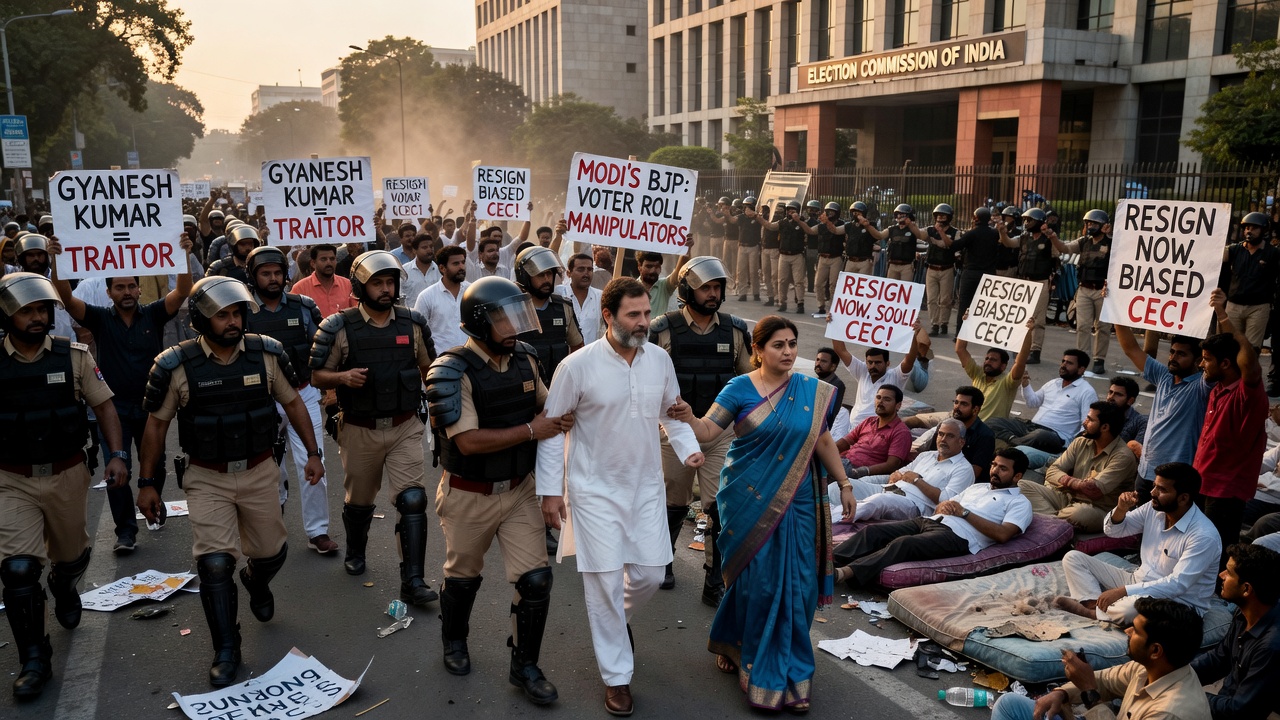
Delhi police dismantled an opposition sit-in on Tuesday and briefly detained Congress leader Rahul Gandhi, his sister Priyanka Vadra and dozens of other lawmakers, who had demanded the resignation of India's chief election commissioner. The protesters accused the Election Commission of India of revising voter rolls in ways that favour Prime Minister Narendra Modi's governing party, an allegation the commission and the Bharatiya Janata Party both reject.
What triggered the standoff
The confrontation followed reporting by the Indian Express last month describing internal disagreements within the Election Commission over how voter lists were being updated. Reuters has not independently verified that account, and Chief Election Commissioner Gyanesh Kumar has not publicly addressed it. Congress and allied parties nonetheless seized on the report to argue that the commission, whose leadership is appointed by the government, has compromised its neutrality. The BJP has dismissed the claims as misleading.
Lawmakers marched from parliament to the commission's headquarters, carrying placards branding Kumar a "traitor" and accusing the BJP of disenfranchising voters. The march drew in student groups and the youth-led "cockroach" movement, part of a string of near-daily demonstrations that began last week. Security personnel in riot gear blocked the marchers from entering the building, and the group settled into a sit-in on mattresses in a nearby compound before police moved in that evening and detained several lawmakers.
Why voter-roll integrity matters
Electoral rolls determine who can cast a ballot, and disputes over their accuracy strike at the legitimacy of any vote count that follows. In a democracy as large as India's, even modest administrative changes to registration procedures can shift outcomes in closely contested constituencies. That is why opposition parties have framed this as a question of institutional independence rather than a routine administrative matter. The Election Commission, for its part, said it had offered to meet the lawmakers but that the proposed venue did not conform to its protocol, and that the lawmakers rejected its alternative of receiving a memorandum through an official.
The episode also tests how a nominally independent regulatory body manages public trust when government appointees sit at its helm. This is not unique to India; election administrators in many democracies face similar scrutiny whenever rule changes coincide with political advantage for the party in power. Transparency around deliberations, and willingness to engage directly with critics, often determines whether such disputes are resolved through institutional channels or spill into street protest.
A test of political pressure mid-term
The protests land midway through Modi's third term and follow a separate episode earlier this year in which comparable public pressure forced the resignation of his education minister over exam paper leaks. That precedent gives the opposition a template: sustained, visible demonstrations that keep an issue in the news cycle long enough to force a response. Congress President Mallikarjun Kharge cast the current campaign in existential terms, telling reporters the commission had become "a puppet in the hands of the government" and that the fight was "to save our democracy."
Whether the pressure yields any change to the commission's leadership or its procedures remains unclear. What is already evident is that voter-roll integrity has become a live political flashpoint, with implications for how upcoming elections are contested and perceived. For a body whose authority rests entirely on public confidence, the dispute over process may prove as consequential as any single ruling on registration rules.