
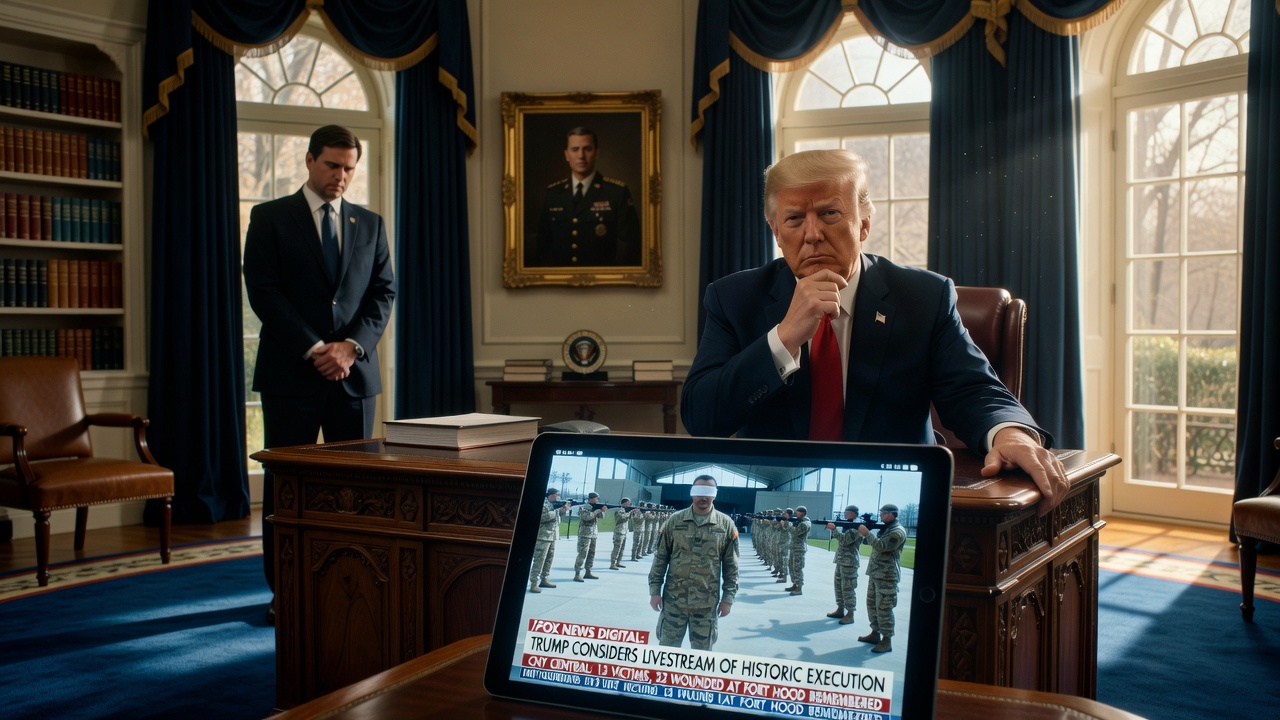
President Donald Trump said Saturday he has not made a final call on whether the firing squad execution of Nidal Malik Hasan, the former Army major convicted in the 2009 Fort Hood shooting that killed 13 people and wounded 32 others, will be broadcast live. The Pentagon had already told Fox News Digital the execution was scheduled for December 3 and set to be livestreamed, but Trump's remarks at the White House make clear the decision is still his to finalize. The case marks the first military execution in more than six decades and the first by firing squad since 1945, a historic break from decades of practice that has drawn attention well beyond military and legal circles.
A Decision With No Modern Precedent
There is no recent template for how the Pentagon or the White House should handle public visibility of a military execution. Hasan's sentence was approved years ago, but the method - firing squad - and the proposed livestream format are both unusual enough that officials are operating largely without institutional precedent. Trump acknowledged the tension directly, noting "two thoughts: don't show it and show it," and suggesting a broadcast might serve as deterrence. Vice President JD Vance, by contrast, said he personally would not watch if it airs, underscoring that even senior officials are not aligned on how to treat the moment.
Why the Broadcast Question Matters Beyond the Courtroom
Decisions about whether to record or distribute an execution touch on media ethics, government transparency, and public safety messaging all at once. Historically, executions in the United States - military or civilian - have been conducted with limited witnesses and no public footage, reflecting long-standing concern that graphic broadcast could desensitize audiences, retraumatize victims' families, or be repurposed outside its intended context once released into digital circulation. A livestream, even one tightly controlled by the Pentagon, would almost certainly be clipped, shared, and recontextualized across platforms within minutes, raising questions about how such footage would be moderated or restricted once it left official channels.
Institutional Signals and Political Framing
Trump has said he approved the use of an Army firing squad following a recommendation from War Secretary Pete Hegseth, while distancing himself from the specific livestream decision in earlier comments to CNY Central. That distinction - approving the method but deferring on the broadcast - suggests the administration is treating the two choices as separate policy questions, one procedural and one communicative. Framing an execution as a deterrent example, as Trump suggested, is a long-debated argument in criminal justice policy, and one without settled empirical consensus. The ultimate decision will likely be read as a signal of how this administration balances military justice tradition against modern media dynamics, regardless of the outcome.