
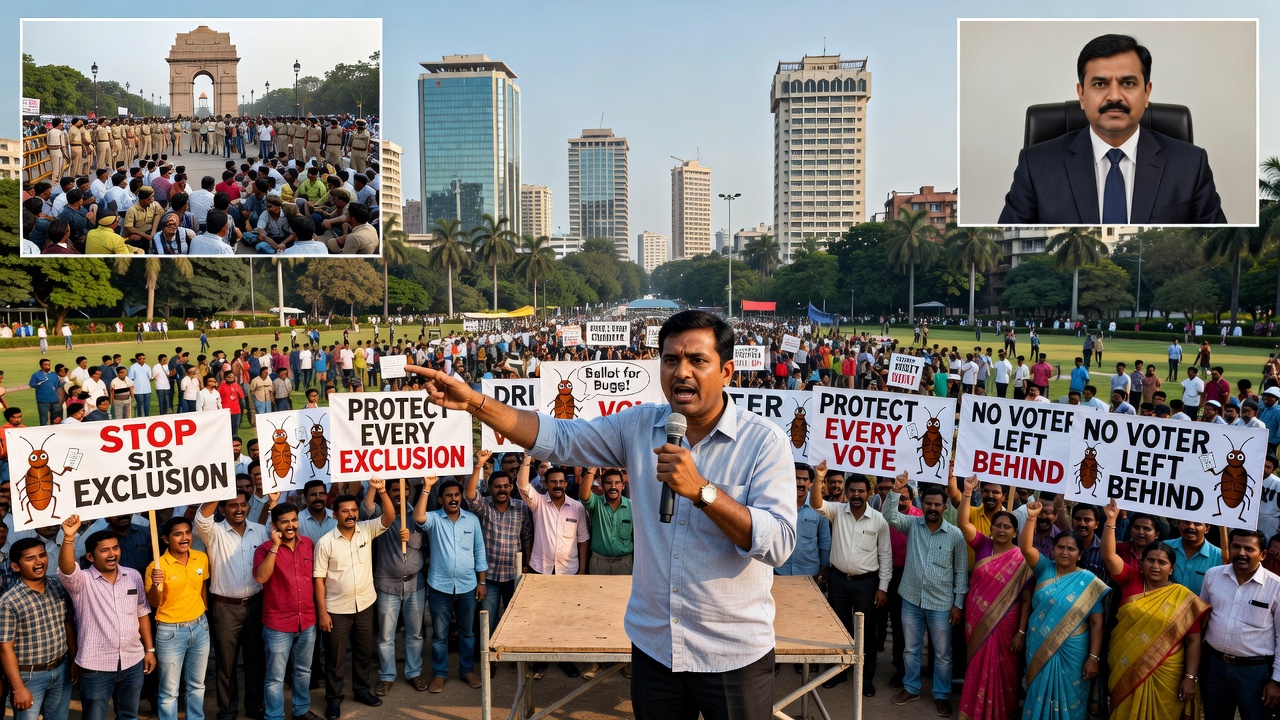
A political party built on satire is making a serious point about electoral administration. Cockroach Janta Party spokesperson Saurav Das told India Today that the demonstration at Mumbai's Shivaji Park against the Election Commission's Special Intensive Revision (SIR) drew a crowd he described as "overflowing," arguing it signalled genuine public unease with the process overseen by Chief Election Commissioner Gyanesh Kumar. The remarks come as similar protests in Delhi resulted in over 1,000 detentions, and as the Commission separately rolled out a special voter enrolment drive.
What the Special Intensive Revision Involves
The SIR is an administrative exercise meant to clean up and verify India's electoral rolls, a routine but consequential function of the Election Commission. Revisions of this scale touch millions of voters and require documentary proof of eligibility, which critics argue can inadvertently exclude people who lack easy access to paperwork - migrant workers, the poor, or those in remote areas. Supporters of the exercise counter that accurate rolls are essential to prevent duplication and fraudulent entries. The tension between administrative rigor and inclusivity is not new to Indian elections, but it resurfaces sharply whenever a revision is announced close to a election cycle.
Why the Protests Matter Beyond Mumbai
Das's comments signal an intent to widen the campaign, with planned demonstrations in Karnataka, Uttar Pradesh and West Bengal before the party returns to Delhi. This geographic spread matters because voter roll disputes rarely stay contained to one city once a political narrative takes hold. The scale of detentions in Delhi - more than a thousand, according to reports - also raises separate questions about how authorities are handling public assembly around an issue that is, at its core, about citizens' access to their own electoral rights. Restrictions on protest venues, which Das specifically criticised, are a recurring flashpoint in Indian civic life, often pitting law-and-order concerns against the right to peaceful dissent.
The Election Commission's Response
Alongside the protests, the Election Commission announced a special voter enrolment drive, a move that can be read as both routine administrative follow-through and an attempt to address concerns about exclusion. Enrolment drives typically aim to capture eligible voters who may have been missed in earlier rolls, though their effectiveness depends heavily on outreach, documentation requirements and public awareness. Whether this drive directly responds to the protests or runs independently of them is not something the available reporting clarifies, and claims about its scope or intent should be treated cautiously until the Commission provides specifics.
A Satirical Party With a Serious Message
The Cockroach Janta Party has built its public identity around parody, yet its intervention here taps into a substantive debate about electoral transparency. Das's framing - that a full park reflects broad public sentiment - is the kind of claim that invites scrutiny on its own terms: crowd size is a visible but imprecise proxy for actual public opinion. Still, the party's stated plan to keep raising questions about voting rights across multiple states suggests this is not a one-off gesture but an attempt to sustain pressure on the Commission through the run-up to future elections.