
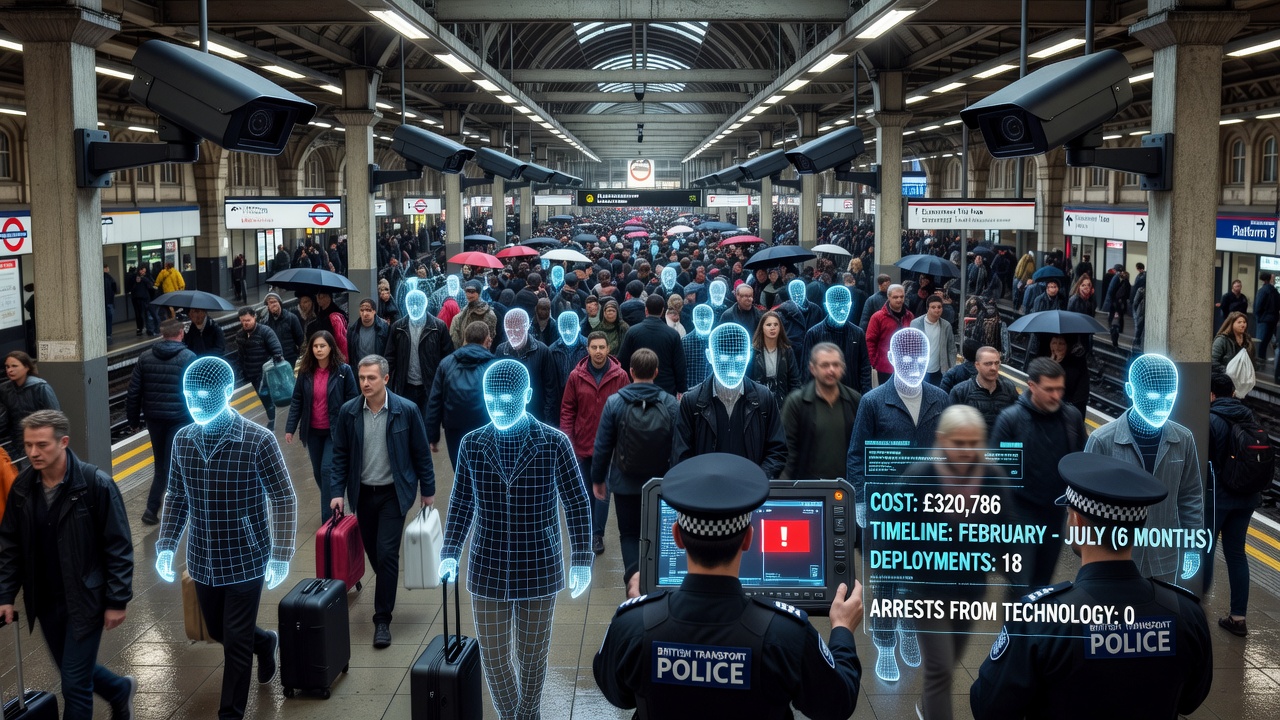
Six months, more than half a million scanned faces, and £320,786 in costs produced a single alert from British Transport Police's live facial recognition trial at London railway stations - and that alert was wrong. No arrests resulted from the technology itself during the trial period, which ran from February to July across 18 deployments at some of the capital's busiest transport hubs.
What the Figures Actually Show
The gap between ambition and outcome here is stark. BTP staffed the deployments with nearly 100 hours of police time, hired specialist equipment, and scanned upwards of half a million commuters, all in pursuit of matches against a watchlist of wanted offenders and people breaching court orders. The sole alert generated during that window was a false positive - the system flagged someone it believed was on the watchlist, and it was mistaken. BTP has pointed out that separate arrests occurred during the deployment period for offences including assault, theft and weapons possession, but the force itself acknowledges these were not the result of LFR alerts and sits outside the technology's own performance data. Since the trial was extended in the following months to include London Underground stations, BTP reports three further confirmed alerts, relating to people found to be complying with sexual harm prevention orders or other court conditions - not new offenders caught in the act.
Why the Numbers Matter for Oversight
Fraser Sampson, the former UK biometrics and surveillance camera commissioner, frames the problem precisely: success for a retailer using facial recognition to deter shoplifting looks like nobody showing up to offend. Success for police deploying the same technology on a transport network looks like catching people. By that measure, the trial's return is thin. Sampson notes that effectiveness depends on multiple variables aligning at once - the chosen locations, the time of day, the composition of the watchlist, and the actual likelihood that a wanted person passes through that specific camera's field of view. Get any one of those wrong and the technology has nothing to find, regardless of how many ordinary commuters get scanned in the process.
This matters because LFR processes what data protection law treats as special category personal data - biometric information capable of identifying someone uniquely. Unlike conventional CCTV, the system is built to actively compare live footage against a reference list in real time. The justification for that level of intrusion rests on the deployment being necessary and proportionate, not merely feasible. A trial that scans hundreds of thousands of innocent travellers to produce one incorrect flag invites scrutiny of exactly that proportionality test, and oversight bodies including the Information Commissioner's Office have already signalled they expect police forces to account for it.
A Wider Rollout, Not a Pause
Rather than stepping back, BTP extended the pilot by four months and widened it to Underground stations. Transport for London has backed the expansion explicitly on the grounds that it will help tackle violence against women and girls at stations chosen for maximum impact. Separately, the Metropolitan Police and the mayor's office have confirmed fixed LFR cameras are being installed in the West End, including on the newly pedestrianised Oxford Street. More than half of police forces across England and Wales have now used the technology on British streets in some form.
That expansion is happening without a dedicated legal framework specific to facial recognition. Parliament's joint committee on human rights has flagged LFR as a particularly clear example of AI-related risk and called for legislation to address it. Bell Ribeiro-Addy, the Labour MP for Clapham and Brixton Hill, has urged a suspension of further rollout until stronger safeguards exist. BTP, for its part, says watchlist growth has been deliberate and controlled, with data quality and safeguarding arrangements built in from the start. The tension is between a technology that police argue is improving with refinement and a public record, so far, that shows little evidence of it working as intended.