
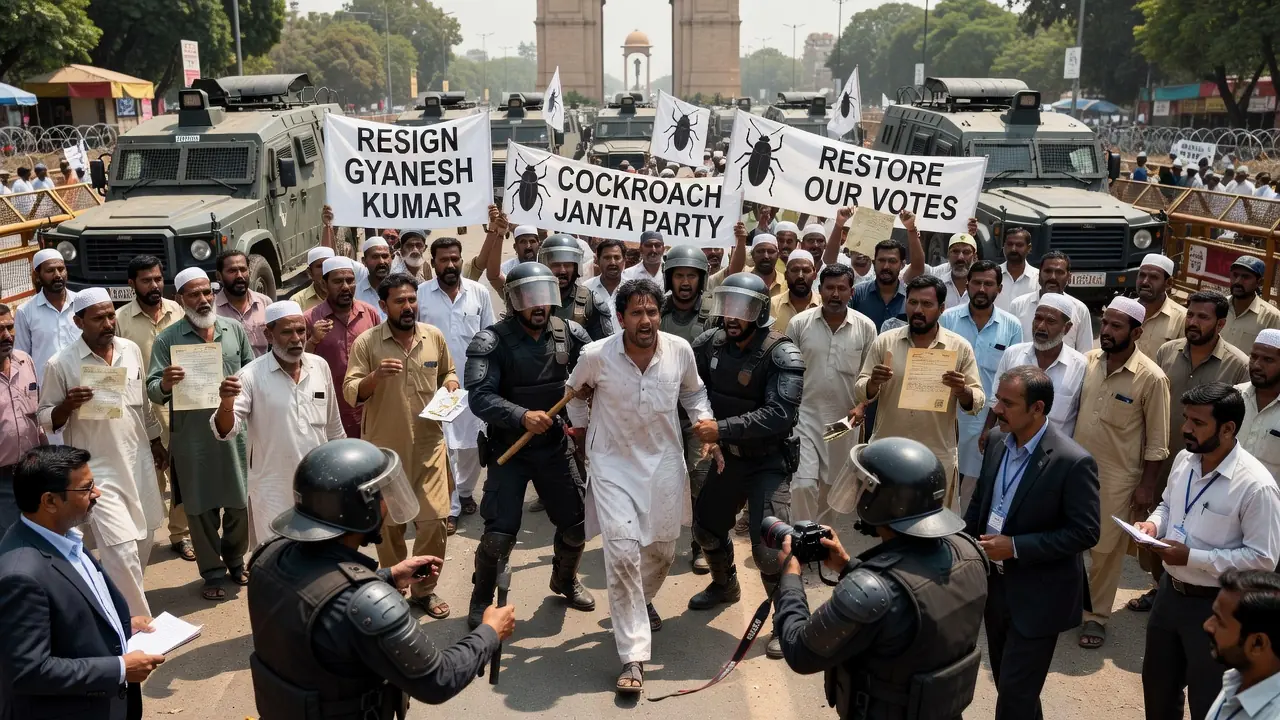
Delhi police detained Abhijeet Dipke, founder of the satirical Cockroach Janta Party, along with hundreds of other demonstrators, to block a planned rally demanding the resignation of India's chief election commissioner, Gyanesh Kumar. Security forces locked down large parts of the capital, suspending travel links and telecommunications as the government moved to prevent thousands from gathering to protest an electoral roll revision that opposition groups say disproportionately strips voting rights from Muslims, migrants, and the poor.
What the voter list dispute is really about
The Special Intensive Revision, launched last year, requires existing voters to re-prove their eligibility using old documents such as birth certificates, land records, or school papers. For a population exceeding 1.4 billion, many of whom lack consistent paper trails spanning decades, this is not a bureaucratic formality - it is a filtering mechanism. A spelling discrepancy in a decades-old record can be enough to erase a name from the rolls. More than 130 million people have reportedly been removed so far. Because welfare entitlements in India are frequently linked to voter registration, losing ballot access can mean losing access to government support as well.
Opposition parties argue the pattern of deletions is not neutral. In West Bengal, where the BJP recently won power for the first time, close to a third of deleted voters were reportedly Muslim. Similar patterns have been described in Bihar, Delhi, and Assam - states where Muslim populations are significant and where support for the ruling BJP has historically been weak. These claims form the basis of a legal challenge now before India's Supreme Court, and of growing public pressure on the Election Commission to explain its methodology.
A protest movement built on satire turns serious
The Cockroach Janta Party began in May as an online joke, mocking a remark by India's Chief Justice that compared unemployed youth and activists to "cockroaches." It evolved quickly into an organised youth movement, successfully pressuring the education minister to resign in July after mass protests over exam-system failures. That early win gave the group credibility it is now spending on a far more sensitive target: the institution that runs India's elections.
The Election Commission maintains the roll revision is overdue housekeeping, meant to remove duplicate or fraudulent entries from voter lists that had not been thoroughly checked in years. Critics counter that the process was rushed, opaque, and conducted with inadequate safeguards for people without ready access to historical paperwork - effectively placing the burden of proof on the most vulnerable voters rather than on the state.
Detentions, press access, and the shrinking space for dissent
Amnesty International has accused Delhi authorities of detaining more than 5,000 people, including opposition politicians, student leaders, journalists, and lawyers, calling it an attempt to suppress criticism rather than manage public order. The Committee to Protect Journalists separately raised concerns about reporters being detained and having equipment confiscated while covering the demonstrations, warning that press access during politically sensitive events is itself a measure of institutional accountability.
The government has dismissed the protesters as fringe actors with no real public backing. That framing will be tested in the coming months. Whether the Cockroach Janta Party can replicate its earlier success against a far more powerful institution - one central to the legitimacy of India's democratic process - remains an open question, and one with consequences well beyond this single protest.